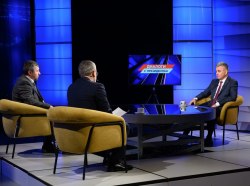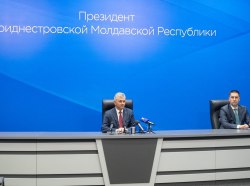
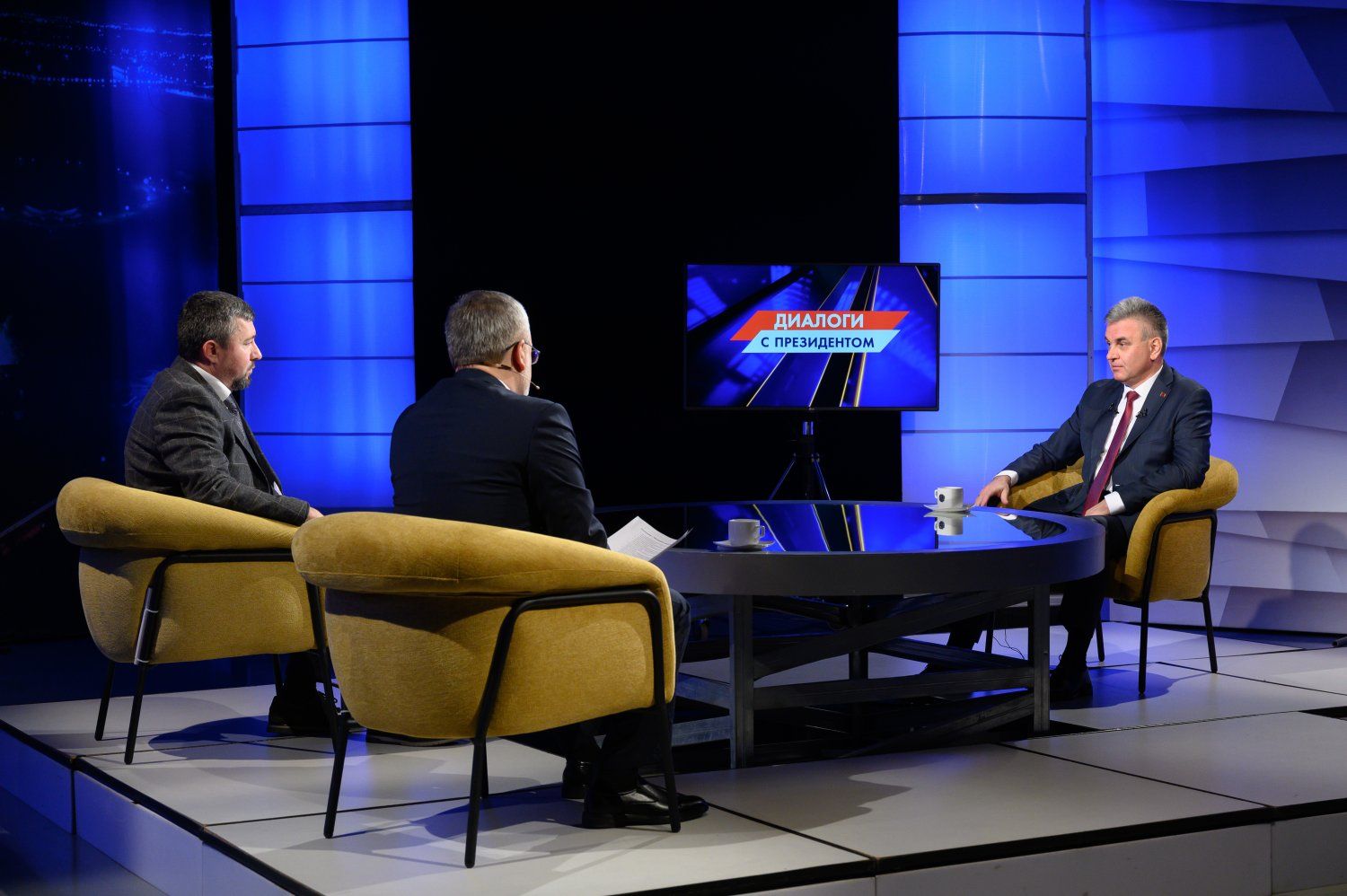
Igor Avrenev, Editor-in-Chief of TSV:
Good afternoon, Vadim Nikolaevich. It's great that you've come before the New Year to talk about what's happened this year.
The PMR President Vadim Krasnoselsky:
Good afternoon. I'm happy to discuss this and answer questions. We have questions of various kinds, of course.
Igor Avrenev, Editor-in-Chief of TSV:
Vadim Nikolaevich, let's start with the first question. You just recently held another international meeting. What do you think is the most pressing issue right now? What's the main problem today, the one causing all the troubles?
The PMR President Vadim Krasnoselsky:
You've essentially given direction to the external factor. This includes the negotiation process, contacts with neighbors, and the dialogues the president is holding with his colleagues. What's really going on? I've been talking about this constantly. I'm not revealing anything new here, I'm not announcing anything new. Something very bad is happening in the negotiation process in fact. The negotiation process hasn't been happening since October 2019. It doesn't exist. It's not being conducted. The "5+2" format is blocked. It was blocked at the initiative of the Moldovan side in October 2019 in Bratislava. They were given the opportunity to return to the negotiating table in November, but Moldova refused. Then came the pandemic, and hostilities began in Ukraine in 2022. So, Moldova and not only Moldova but also some other states in this format, so to speak, have done everything possible to exclude it, declaring the impossibility of returning to the "5+2" format since 2019. I held more than 30 official, public meetings – with ambassadors, with organizations, with commissions, and so on this year. Probably at least 40 meetings last year. These are just meetings. These are meetings, consultations, discussions, but this is not a negotiation process. A negotiation process is a situation where all parties participate, decisions are made, signed, and implemented. This process is missing. Let me remind you what the "5+2" format is. It is a format for the Pridnestrovian settlement recognized by all international participants, and includes Pridnestrovie, Moldova, Russia, Ukraine, the OSCE, the United States, and the European Union. It would seem that all decision-makers, to one degree or another, were invited and participated in this format. All issues were discussed publicly. The format ceased to exist, so to speak, de facto. It exists de jure, de facto, it does not. Following the format, meetings of working groups gradually began to cease. What is a working group? A working group is made up of specialists who discuss specific, line-of-business issues: law enforcement, ecology, healthcare, the economy, and so on. In other words, when politicians make decisions on this or that issue, they should base them on the opinions of specialists. They present then their political decision, naturally supplemented by expert opinions, as a settled matter for signature – as an agreement. That's not the case. It doesn't work. Take political representatives. There haven't been any meetings since April. Moreover, the Moldovan representative is throwing out some kind of preconditions – completely incomprehensible, populist ones. They simply don't want to talk to us. That's all. That's how it is today. All the other issues we'll now touch on – in the area of law enforcement, ecology, healthcare, energy – they're all tied, of course, to what? To dialogue first and foremost. To the negotiation process. There is no negotiation process. There is no normal dialogue. That's not good. We call on all parties to return to the "5+2" format. We are talking about the need to continue dialogue. I don't know of any examples where something ends without a reason. Everything always ends with dialogue and negotiations. I don't know of any other examples in the world. Maybe someone does, but I don't know. One thing I can say is that the parties aren't ready for this yet. Not yet. But this will pass "for now", and the negotiation process will resume.
Dmitry Matveyev, Editor-in-Chief of the First Pridnestrovian TV Channel:
There are social and economic issues during political dialogue, during political issues and discussions. Are they also politicized now?
The PMR President Vadim Krasnoselsky:
Unfortunately, everything is politicized now, in my opinion. I have always been a proponent of separating politics from common sense, in the sense that decisions must be made on current issues. Here's an example. Environmental issues. Our sanitary services have been collecting water from the Dniester River for two years. Specifically where small rivers flow in from Moldova, from the right bank. What are we observing? We see pollution levels exceeded by a factor of 200-250, according to our tests, which are conducted in the appropriate laboratories. I'm not even talking about the tests we don't conduct: for heavy metal content in these waters, and so on. Is it a problem? It's a problem. Why is this happening? Well, that's clear. Moldova's wastewater treatment facilities can't handle the volume of discharge. Wastewater disposal systems are malfunctioning, and all of this flows directly into the Dniester River. Add to this the number of vehicles, which has increased significantly, and the number of facilities, which is also growing all of this puts a strain on both the treatment facilities and the environment. Is this a problem? Absolutely.
Igor Avrenev, Editor-in-Chief of TSV:
Is this being discussed with Moldovan politicians?
The PMR President Vadim Krasnoselsky:
Exactly, it's only being discussed. When various commissions come to me, such as the European Commission, the OSCE Mission, individual ambassadors from Western countries, I say: gentlemen, let's put all politics aside and not politicize this issue. What is being proposed? The creation of a joint commission, plus the involvement of independent experts, is being proposed. That is, it should include representatives from Pridnestrovie and Moldova, plus independent experts. Let the OSCE Mission and the European Union contribute to this. Of course, with a laboratory. With a laboratory capable of assessing the true state of the Dniester River. It's only one river, you see? It flows along Ukraine, Moldova, and Pridnestrovie. Many cities and regions drink from it. We wonder where all the cancer cases come from then. I'm not making a direct connection, of course, but there are cause-and-effect relationships here. Especially among young people, among children. The problem is truly environmental. This is one of the factors in solving the disease problem. I say: let's create a commission based on the working group. Let this commission, with a reinforced laboratory, measure wastewater. We'll develop an algorithm for solving the problem only after the true picture is clear: allocating funds for repairing treatment facilities, building new ones, and so on. Let the experts talk about that. I'm not an expert in this field, but I understand that something needs to be done if the Dniester River is more than 200 times polluted. Is this of interest to the political representative? We've sent all the information, including the test results from our sanitary service.
Igor Avrenev, Editor-in-Chief of TSV:
What's the response?
The PMR President Vadim Krasnoselsky:
Nothing.
Igor Avrenev, TSV Editor-in-Chief:
Vadim Nikolaevich, just the other day, our customs officers discovered more drug stashes on the border with Moldova. This isn't the first such incident in the past year. There have been quite a few cases of drugs smuggled from Moldova into Pridnestrovie. Is there any cooperation between law enforcement agencies in Moldova and Pridnestrovie?
The PMR President Vadim Krasnoselsky:
I'll start with a slightly different point. These new times and they are new, completely new are linked to major geopolitics, linked specifically to geopolitical catastrophes. They are certainly leaving their mark on the border regions like Moldova, Pridnestrovie, and others. I'll be talking about Moldova and Pridnestrovie. We all saw the reports of Romanian customs officers seizing weapons being transported through Moldova. They were seized in Romania. We've all seen the information, I think from the Prosecutor General's Office, about the seizure of a large shipment of drugs. Our law enforcement agencies, including the Customs Committee, have detained 16 people who were attempting to smuggle drug-containing mixtures such as synthetics into Pridnestrovie this year, you understand. 16 detained. From Moldova to Pridnestrovie. Do you understand? This is a disaster. Of course, Moldova cannot be blamed here. Absolutely not. Moldova is a victim. We are victims too. We must somehow fight this evil. Must we fight it? We must fight it. We are fighting it, of course. We have detained the smugglers; they have all been arrested and will be convicted. What is being proposed? Options are being proposed for cooperation between the law enforcement agencies of Pridnestrovie and Moldova. All this happened once upon a time. Agreements were signed between the Ministry of Internal Affairs of Pridnestrovie and the Ministry of Internal Affairs of Moldova, which provided for this cooperation in 1999 and 2001. What did they include? The exchange of reports, the exchange of information, the holding of joint events, and so on. I won't go into detail; it's clear. Cooperation. Moldova officially withdrew from these agreements in 2004. There's no point in talking about any kind of normal cooperation in fact. It's all on the verge of risk, based on some kind of local agreements so to speak. That's not good. We're putting both militia officers and police officers at risk. There's no legal basis for such cooperation. Do you understand? If something happens and there are such examples who suffers, God forbid? The perpetrators. The militia officers and the police officers. Those who protect the law and citizens. That's bad.
Igor Avrenev, Editor-in-Chief of TSV:
The criminals are moving.
The PMR President Vadim Krasnoselsky:
So, what's being proposed? Of course, normal cooperation is proposed. But imagine. Let's say we've detained an offender. There's established cooperation. Some documents have been signed. Everyone knows their task. First, there's the exchange of reports, the exchange of information. So, police and drug enforcement officers see the report and understand that a drug courier has been detained in Pridnestrovie. Coming from Moldova, right? Coming from Moldova, carrying drugs, detained, a large shipment, and arrested. A police officer can come to Pridnestrovie with normal cooperation, talk to him, interrogate him, obtain all the materials – copies of them. Try to unravel the supply chain, using this model. After all, it's coming from Moldova, not from Pridnestrovie to Moldova, from Moldova to Pridnestrovie. That is, they can then work on the clients or organizers of these criminal drug supply schemes. This is a small example regarding drugs. What do we see? Politicization.
One of the first documents the Parliament of the Republic of Moldova adopted after its election was the 10-Year Military Strategy. We see old approaches, old stereotypes, and lies. One of the most important issues that parliamentarians voted for (almost 100% voted for this doctrine) is "the threat of arms smuggling into and from Pridnestrovie". Do you understand? But they don't see today. They don't see that there's a war going on in Ukraine. That various groups can take advantage of this illegally and engage in criminal activity, of course. It's convenient for them, you see?
Dmitry Matveyev, Editor-in-Chief of the First Pridnestrovian TV Channel:
There is the concept of common sense.
The PMR President Vadim Krasnoselsky:
Do you see? Common sense. It clashes with politicians. Not always, but very often. Sometimes I even call myself not a politician. I'm not a politician in fact. I'm the President. It doesn't suit me what is currently understood by "politician". What is meant by "politician" is a deceitful person who doesn't keep their word. That's a politician. That's the definition of a modern politician. It's not true. There have been worthy politicians. Of course there have been. They've been everywhere. I even know them. Worthy people, worthy politicians who keep their word. What has now been turned into the term "politician" doesn't suit me. That's why I say: I'm the President. I must tell the truth as it really is. That's all. Well, call me a politician for God's sake. I understand the word differently.
Dmitry Matveyev, Editor-in-Chief of the First Pridnestrovian TV Channel:
Is there more common sense or politics in Chisinau?
The PMR President Vadim Krasnoselsky:
Let them judge for themselves. I haven't yet seen any results from my proposals in fact in terms of ecology, in terms of law enforcement and security in general at least. This is wrong. We need to make decisions based on common sense, not based on, let's say, political forces that will support it or not. There is common sense. You understand. What is a drug? All the members of Moldova's parliament, all the leaders of Moldova, all these people have relatives, they have children, they have grandchildren. You must understand that they are at risk. If it overwhelms Moldova, it will spread to Pridnestrovie, of course. We will fight it, that's for sure. There are no other options here. I propose we do this together. Criminals are taking advantage. They are exploiting this policy, which destroys all mechanisms and contradicts, as we said, common sense by and large. Of course, I'm not blaming Moldova for anything that goes through them. Absolutely not. I repeat, they are the victims in this regard. We need to join forces and fight together. That's the message. By the way, not only in these areas, but also in many others.
Igor Avrenev, Editor-in-Chief of TSV:
One of the most pressing issues is energy security. Here's probably the main question facing Pridnestrovians heading into the New Year: will what happened a year ago repeat on January 1, 2026?
The PMR President Vadim Krasnoselsky:
There are always risks, of course. But the republic's leadership and I personally, my subordinates, staff, and the government are doing everything possible to prevent this from happening. Of course, the Russian Federation is no exception. I'm confident that the situation that occurred on January 1, 2025, will not repeat. What I want to say, that I'm observing, I'm participating in the process, I'm analyzing all the processes, and I'll say this, you know: even taking into account the interruption of gas supplies through Ukrainian territory to Pridnestrovie and the consequences that arose, much could have been avoided or shortened in time. What if? If there had been direct negotiations, if there had been direct dialogue. I must give credit to the Moldovan side; I'm grateful to them for that, too. They understand the situation, they're helping in some ways, they're accommodating. That's true. So, this is already joint work. I can't in any way blame Moldova for currently obstructing gas supplies to Pridnestrovie. That's not true. On the contrary, there's an understanding that the left bank of the Dniester cannot be abandoned, that Pridnestrovie cannot be left without gas, without energy. I see joint work here. An example of interaction, normal interaction, is the working group on the economy, headed on our side by Sergei Anatolyevich Obolonik. The results are visible. We see stability, albeit very weak. Thanks to this work, this working group, which, by and large, is part of the "5+2" format, we're seeing results. We're seeing results, which is that Pridnestrovie now has both gas and electricity. That's an example.
Dmitry Matveyev, Editor-in-Chief of the First Pridnestrovian TV Channel:
What about the prospects?
The PMR President Vadim Krasnoselsky:
Regarding the prospects: everything will be fine. Everything will be fine.
Dmitry Matveyev, Editor-in-Chief of the First Pridnestrovian TV Channel:
Another important topic, a problem we constantly see in Moldova, often shown on television, is the active buildup of military potential in Moldova. We see new weapons systems that they are mastering and actively demonstrating. How do we feel about this, given that the population perceives this with considerable concern?
The PMR President Vadim Krasnoselsky:
Weapons come in different forms. Some are defensive, and some are offensive. When Moldova acquired defensive weapons systems, there was generally no significant unrest. Although, of course, defensive weapons can be used offensively in certain situations, but ultimately, direct action is defense. These are air defense systems and other defensive systems. We see that Moldova is suddenly acquiring offensive weapons. For example, 152mm wheeled howitzers with a range of up to 42 km. I'm asking my colleagues from the OSCE, European colleagues, and others: why? Where are they going to shoot at 42 km? I'm curious. Where are you planning to shoot? You see, they say there's a war in Ukraine, of course, the state must arm itself. Yes, I understand. Why offensive howitzers? 42 kilometers. Do you understand? That's the question. No one has really answered it clearly. We're monitoring this too; it concerns us. There's also information they themselves boasted about, that they have a large number of FPV drones. But why? FPV drones are clearly offensive weapons, not defensive. They're a deterrent at the very least, but also offensive in nature, of course. I understand there's a general hysteria surrounding the geopolitical issue and the military actions in Ukraine. Everyone's probably fussing and freaking out about this whole situation. It's understandable. I understand it's having a significant impact on our neighbors, as I said earlier. We're still monitoring, analyzing, and asking questions. Do you think Moldova's political representative will answer the question of why they need this type of howitzer? Unlikely. He'll simply avoid dialogue. That's all. It's easier that way.
Igor Avrenev, Editor-in-Chief of TSV:
Vadim Nikolaevich, regarding the actual proposal. Moldova refused to purchase electricity from Pridnestrovie, from the Moldovan State District Power Plant. People in Moldova themselves have been asking recently: why are we buying expensive electricity? They've finally asked the question. Why is Moldova buying expensive electricity from Romania and not buying cheaper electricity from Pridnestrovie?
Dmitry Matveyev, Editor-in-Chief of the First Pridnestrovian TV Channel:
Considering that at their peak, the prices there are incredible.
Igor Avrenev, Editor-in-Chief of TSV:
Yes, they were selling for up to 400 euros per megawatt. Is the Moldovan State District Power Plant capable of selling electricity to Moldova for less than the Romanians?
The PMR President Vadim Krasnoselsky:
Let's start with the fact that the basic component here is the price of gas. There are exchange prices, they allow for cheaper electricity generation at the Dnestrovsk State District Power Plant today. That's a fact. Furthermore, the Dnestrovsk State District Power Plant has an electricity export license and can, de jure, supply this electricity to Moldova, as far as I know. The issue is commercial. We previously proposed operating options for this particular plant, and Inter RAO management also proposed operating the plant on tolling gas. In other words, Moldova supplies gas and receives electricity. What's our interest? Well, of course, it's the company's capitalization. It's the full scale of the entire team's work. It's taxes that will go to the budget of Pridnestrovie. So, we also have our own interest, a small one, but still. We're interested in the operation of the plant. Therefore, the issue shouldn't be political, but economic, of course. If it's profitable, go ahead. Without preconditions or unnecessary politicization. Again, it's a commercial issue. Let these specialists in this field refine it.
Igor Avrenev, Editor-in-Chief of TSV:
Do you think Russia will continue to provide support? We've relied heavily on Russia's support so far. Many senators and State Duma deputies before the parliamentary elections in Pridnestrovie expressed their parliamentary view that they are Russia, they are ready. As the PMR President, in your interactions with Russian government officials, to what extent do you feel that Russia's assistance will continue? There's a lot of speculation right now that "Russia has abandoned Pridnestrovie, that's it..."
The PMR President Vadim Krasnoselsky:
Let's start with the fact that we have and if you've read it carefully, or maybe you did and have already forgotten the Development Strategy of the Pridnestrovian Moldavian Republic, which was adopted in 2018 for an eight-year term, first of all. You remember it, right? The presidential decree. This decree sets forth the state's vision and our foreign policy. In 2018. Back then, many weren't just criticizing, they were even chuckling: "Eight years..." So what? Eight years. The eighth year is already underway. Pridnestrovie conceptually lives by this very development program of the Pridnestrovian Moldavian Republic by and large. Once the eight years are up, another decree will have to be issued to extend the Pridnestrovian development program. So, it says everything there about foreign policy, absolutely everything. That we maintain friendly relations with our neighbors Moldova and Ukraine. We build dialogues for the sake of peace and stability throughout the region. Of course, we have trade cooperation and economic cooperation. Of course, we have strong, good ties with the Russian Federation.
I'll focus on the following point. Look. What is Pridnestrovie? Whose part were we? We were part of the Russian Empire, we were part of the Soviet Union. Note this very interesting fact. No one talks about it some reason. It's somehow visible, not celebrated. After all, the city of Tiraspol was founded by Generalissimo Suvorov (then Field Marshal Alexander Vasilyevich Suvorov). Suvorov won 70 victories in 70 battles. A great commander, a genius of the art of war. Alexander Vasilyevich founded only one city – Tiraspol, which never changed its name. Here's the most interesting point: the city of Tiraspol never changed its jurisdiction in its entire history, over 200 years. Only at the time of the Nazi Romanian occupation, the city of Tiraspol what is known as “transnistria”, as they called it. So, it was either in the Russian Empire, or in its successor state – the Soviet Union, or in its successor state – Pridnestrovie. Do you understand? That's all. Was it a coincidence? Did it just happen somehow? No. It's all natural. They're all links in the same chain. It's our historical legacy. So, we have a vast shared historical legacy with the Russian Empire, the Soviet Union, and its successor state – the Russian Federation. More than 220000 Russian citizens live here. We have very close cultural and humanitarian ties, educational, economic, peacekeeping, and so on. Of course, Russia will help. Who doubts it? Will Russia abandon 220000 Russian citizens to their fate? No. That Russia will watch as the territory of Pridnestrovie is turned into some kind of ghetto? Such thoughts are heard from the right bank: "Let's construct a barbed wire fence". No, of course not. Russia is acting as the guarantor of peace here. A peacekeeping operation is being conducted here under the auspices of Russia, which includes both Moldovan and Pridnestrovian peacekeepers. Therefore, Russia will assist, of course. We very much hope so.
Dmitry Matveyev, Editor-in-Chief of the First Pridnestrovian TV Channel:
Considering the current turbulence surrounding Pridnestrovie, what are the current objectives of the peacekeeping operation? What is the level of interaction with the peacekeepers? Considering that the Joint Control Commission, which is currently operating, is the only format where all parties, including those in conflict, are present at the negotiating table.
The PMR President Vadim Krasnoselsky:
Yes, the peacekeeping mission existing on the banks of the Dniester is under the auspices of Russia. As I already said it includes peacekeepers from both Pridnestrovie and Moldova. It has proven its effectiveness. There is peace on the banks of the Dniester. Period. That is the result. The mechanisms are in place: the Joint Military Command, the Joint Control Commission. Of course, there are heated exchanges. So what? That's probably how they're supposed to work. Perhaps that's the way it's built, when truth is born in debate. The most important result is peace on the Dniester. Period. Other formats are unimaginable today.
Igor Avrenev, Editor-in-Chief of TSV:
Moldovan politicians are now frequently talking about the need for money for the reintegration of Moldova and Pridnestrovie. Is this their way of "begging" for money, that is, simply finding money somewhere for something else, for some plan, for some political process?
Dmitry Matveyev, Editor-in-Chief of the First Pridnestrovian TV Channel:
Considering especially that we hear very contradictory statements about what kind of reintegration they envision – sometimes with Pridnestrovie, sometimes without Pridnestrovie, they plan to join the European Union.
Igor Avrenev, Editor-in-Chief of TSV:
The same Moldovan politicians say "with Pridnestrovie" today, and "without Pridnestrovie" tomorrow – but give us money.
The PMR President Vadim Krasnoselsky:
There's a famous Soviet cartoon where the characters said, "Do we have a plan?" Remember that?
Dmitry Matveyev, Editor-in-Chief of the First Pridnestrovian TV Channel:
Mr. Fix.
The PMR President Vadim Krasnoselsky:
Yes, yes, "Do you have a plan, Mister Fix?" Perhaps, if someone requests funds from someone, it should be done on the basis of some kind of plan, an action plan, a document. I don't know about such documents. I've heard countless stories about programs, documents, algorithms, plans in my tenth year as president. So what? It's all just talk, really. No one discussed them. That's clear, with Pridnestrovie. They haven't discussed them with the other parties. How can this be without discussion? Without dialogue? Without a negotiation process, by and large? I'm not even prepared to comment on who's asking whom for what. It's difficult for me to discuss this because I haven't seen anything, no evidence. That's the first thing. Secondly, the citizens of Pridnestrovie weren't asked about reintegration or the European choice, and so on. They should be asked. The Pridnestrovian people, the multinational Pridnestrovian people, live on the territory of Pridnestrovie. These people should be asked. Only these people decide their fate, the future of their state, the future of their territorial structure. There's no other way. If anyone thinks of blurring it, of somehow dispersing it, of creating a problem, saying, "People will disperse..." no, people won't disperse. People will live here. The Pridnestrovian people.
Igor Avrenev, Editor-in-Chief of TSV:
But there's some kind of preparation underway, so to speak, for a change in the mentality of Moldovan citizens, of Moldovans. Politicians are erasing them, claiming that there are no Moldovans, and that instead there are Romanians living in Moldova. The process of rewriting history is very active this year. Scandals with their high-school history textbook, where experts found over a hundred inconsistencies. They call the fascists liberators; those who came and executed 18000 people in Dubossary. They were some kind of liberators, in their opinion. At least, that's what they teach their children. Now they're erecting monuments to the soldiers of the Romanian army who attacked on June 22, 1941. With an honor guard, with military honors. It's understandable that people, perhaps even burial sites, should be treated with humane respect, but this glorification is taking on a rather serious scale.
The PMR President Vadim Krasnoselsky:
No, just a second. That's the wrong line of thought, Igor. Let me correct you. Look. Actually, look at how the so-called defeated states live those who were part of the Axis: Nazi Germany, Romania, Italy, Finland, Hungary, and so on. There were Axis powers, there were satellites, there were allies. Practically all of Europe. What did we see? We saw that they were doing just fine even after World War II. Were they defeated? No, they weren't. Who said they were defeated? They're doing great. They're doing well. They have, as their politicians say, a "European garden" built on the bones of the Soviet Union's inhabitants, Jews, and Soviet liberator soldiers. Well, they built it as it is. I'm still drawing a different parallel and a different doctrine. The Nazi-fascist ideology lost in that war, in World War II. Do you understand? The ideology. These countries, like Romania, Germany, Italy, and all the others, they were victims. Victims of this ideology. This is important to understand. It was the Red Army that liberated these peoples from the enslavement of this ideology. Let's take, for example, even the Germans, their elite SS units. A very large percentage of SS men had academic degrees. They were all educated people, they had higher education. They were the elite, in fact, as they believed, the intellectual elite of Europe. They designed and manufactured gas chambers on an industrial scale, gas plants for killing people. They built crematoria. They developed all sorts of methods for the mass killing of people. What happened to them? They were supposedly intellectual, educated people. They all have children. Look, they killed a thousand people today and came to his children, smiling, playing with them. How does this fit together? It's really hard to understand. The answer is simple. The Nazi-fascist virus it eats away at the brain, at common sense. It turns a person into more than just an animal. Animals don't act that way, don't insult animals. It turns them into subhumans. It's some kind of intermediate state between human and animal. It's subhuman. That's Nazi-fascist ideology. It was the Red Army and the Soviet soldier who liberated Europe from Nazi-fascist ideology. At great sacrifice, in fact. A very great sacrifice was made in that struggle. If we take those Romanian soldiers, those Romanian monuments, so what? Well, they erect monuments to those who died in that war. They are, by and large, victims of that same ideology. But with what meaning, with what approach, are they erecting these monuments? Is it simply to commemorate these people who died in that war? That's one question. But it's quite another when they say they fought against Bolshevism or the Soviet Union, and they are heroes. That's a different question. Do you understand? It's a completely different approach. What's so frightening about modern Moldova? What makes us so different? Take the history textbook that's been discussed more than once. Let's even start with the title. "History of the Romanians and General History". Tell me, why should we here in Pridnestrovie study the history of the Romanians? Why is that? I'd like to address the President of Romania, Nicusor Dan. Why should we in Pridnestrovie, on the left bank of the Dniester, study the history of the Romanians? Who will answer this question? We never had Romanian statehood. Only when there was so-called region of the Nazi-fascist occupation, where the so-called “transnistria” Governorate was created for the Romanians, where 400000 people were killed. 400000 confirmed casualties. For example, 18000 people were executed in Dubossary. That's the bare minimum. Yes, it was the robbery of the people, of course. These "History of the Romanians" textbooks rehabilitate fascist collaborators – all these monsters, including Antonescu calling him a competent administrator. Yes, a very competent administrator at exterminating people. Therefore, there will never be Nazi-fascist propaganda in Pridnestrovie, of course. There will never be revanchism, either in terms of reviving Nazi-fascist ideology or rehabilitating those who assisted fascism and Nazism in that terrible war. Pay attention even to these textbooks. No one asks the question. It would seem that these textbooks were published for Romanian schools. There are five of them in Pridnestrovie. Why are the textbooks published in Russian? Why are they published in Russian? These are Romanian schools, so publish them in Romanian. No, in Russian. For smoother distribution. Not everyone, even in these schools, understands Romanian perfectly. That's propaganda. Propaganda that they're trying to transfer from the right to the left bank in terms of rehabilitating Nazism and fascism. Moreover. This wasn't my idea, by and large. There are highly respected platforms Jerusalem, Bucharest, Washington, and European platforms that study the history of the Holocaust. They openly state that this textbook rehabilitates fascism and Nazism. This is unacceptable. There's a similar conclusion.
Studying at our Pridnestrovian State University. It's true. That's why I think this is simply unacceptable for us. Finally, I'd like to point out something. Notice how different we are. We have different peoples, different languages. Our heroes that's the most important thing, they are different. Their heroes are those who killed, our heroes are those who defended and liberated. How can this be reconciled? Well, let them show us a plan. Let’s return to the plan. Do you have a plan? I find it hard to imagine. How can this be reconciled? Even the notorious terrorist Ilascu. He was a terrorist, a murderer. He killed civilians on the territory of Pridnestrovie. There, he's a hero. National mourning was declared. I won't comment. It's just a fact. He's a criminal, there, he's a hero. That's all.
Igor Avrenev, Editor-in-Chief of TSV:
Well, here he was killing "separatists," here he was killing Pridnestrovians, and there he was... So to speak, you can look at it differently.
The PMR President Vadim Krasnoselsky:
This could already be classified as Nazism, nationalism, xenophobia, you understand? This is also prohibited by the UN – singling out people based on certain characteristics. Even more so, causing their death. That's all.
Dmitry Matveyev, Editor-in-Chief of the First Pridnestrovian TV Channel:
Only for their political views.
The PMR President Vadim Krasnoselsky:
So what can I say about that? I'm talking about heroes. Everyone has their own heroes. That's all.
Dmitry Matveyev, Editor-in-Chief of the First Pridnestrovian TV Channel:
Vadim Nikolaevich, an important event took place in Pridnestrovie – the elections to the Supreme Soviet. How do you assess the importance of this event, especially given the current situation?
The PMR President Vadim Krasnoselsky:
I'll start with the essence of elections. Everyone's used the word "elections" but there's a deeper understanding. What do people choose? They elect their representatives the Supreme Council and they also elect deputies to city and district councils. These are their representatives. Through them, they can raise issues, initiate legislative initiatives, and so on. Essentially, when councils, when parliaments, govern the state, what should this state be called? What, in your opinion?
Igor Avrenev, Editor-in-Chief of TSV:
A parliamentary state.
The PMR President Vadim Krasnoselsky:
If we translate it into Russian? What is the name of the parliament?
Dmitry Matveyev, Editor-in-Chief of the First Pridnestrovian TV Channel:
Soviet?
The PMR President Vadim Krasnoselsky:
A Soviet state. See where we've come? But the whole problem under the Soviet Union, unfortunately was that the Soviets didn't govern the state in my opinion. That was the problem. The Soviet Union was governed by a handful of politicians. The state collapsed when they turned traitor. Now, if the Soviets had governed the state the Soviet Union as they should have, I assure you, it would still exist today. Look at how the European Union builds its democracies now. They are largely parliamentary states. The overwhelming majority are parliamentary states. What do they call it in Russian? Soviet.
Igor Avrenev, Editor-in-Chief of TSV:
Soviet European Union.
The PMR President Vadim Krasnoselsky:
Parliament forms the government, elects the prime minister, and so on. It's a parliamentary state. This applies to power and its deep understanding. What about Pridnestrovie? Pridnestrovie is a presidential republic, but our powers and responsibilities are very harmoniously distributed among the President, the Supreme Council, the executive branch the Government and, of course, the courts. Everyone does their job. I, as the guarantor of the Constitution, am guided by common sense. I strictly adhere to a clear separation of powers. Everyone should focus on their own functions and not usurp the powers of another branch of government. This is my task as President. Therefore, when the people made their choice, they were shaping the power of the Councils, the power of the Councils of Pridnestrovie both the Supreme Council and the city and district councils, of course. Naturally, they were choosing their present and future. I was surprised to see how this irritated our neighbor Moldova with certain statements. You understand, dear gentlemen from Moldova, those who are doing this are provocateurs. Or do you think that if there is no elected government, Pridnestrovie will be without power? If the people don't choose, some other people will. Why do you need that? We are neighbors. On the contrary, you should welcome it when the people of Pridnestrovie elect their government publicly, democratically. There must be stability here. You, after all, are not fully coping with drug and arms trafficking. Therefore, a neighbor must be sane and be a help in this, of course. I am thinking from the perspective of global stability. How can there be no government? I also believe that the choice has been made in Moldova. The people elected parliament. Of course, there were more scandals there, but still, thank God, everything is finished, and there is power. That's wonderful. How could it be otherwise?
Dmitry Matveyev, Editor-in-Chief of the First Pridnestrovian TV Channel:
Pridnestrovie besides external priorities has internal priorities naturally. What are they for the coming year, and which ones can be identified as top priorities?
The PMR President Vadim Krasnoselsky:
Well, first and foremost, you know, the most global, the most important, the most fundamental – peace. Peace in Pridnestrovie, peace on the banks of the Dniester. That's it. I welcome the statement by the Moldovan leadership that they support a peaceful resolution of the Pridnestrovian issue. A peaceful solution. Through dialogue, negotiations – which, admittedly, aren't happening, but nevertheless. There have been statements, and that's encouraging. I hope that common sense will prevail over the desire of certain forces to provoke this or that problem. The second priority is maintaining all the mechanisms that support the functioning of the state, of course. We must protect and maintain law and order in Pridnestrovie, provide healthcare, education, kindergartens, pensions and benefits, wages, development, investment, and so on. That is, essentially, everything we do every year. 2026 will be little different from 2025 or 2024 in principle. We must address any problems that arise. Address them at the proper state level.
Igor Avrenev, TSV Editor-in-Chief:
Vadim Nikolaevich, this is an important question. Any discussion of the budget or funding, whether to cut or maintain funding, always touches on social programs. This includes healthcare, the treatment of Pridnestrovians abroad, prosthetics, assistance to heart patients, and so on. What will we focus on in 2026? It's clear it's difficult, but still...
The PMR President Vadim Krasnoselsky:
We will definitely fulfill all our social obligations. That's the first objective of this budget. Of course, there is a deficit, there are problems, there are disputes between the government and the Supreme Council, in which the President is also involved. This is normal, given the current situation. Yes, there have always been disputes. I don't remember a single budget that was passed without debate, even when there was money. There are more disputes now, when there is much less money. That's life. It's normal. We must be prepared for this. We must overcome this. Nevertheless, life is difficult. People need help. Therefore, in addition to fulfilling our social obligations, we are focused on healthcare. We will continue to treat certain categories of patients outside the republic. This primarily concerns cardiac issues. Furthermore, there are categories of children who require medical examination and appropriate medical care. We are working with the Russian Federation to ensure that the Russian Federation provides a quota for minors, for the treatment of children at the expense of the Russian Federation budget, within the Russian Federation – treatment that we cannot provide in Pridnestrovie. This is all that is being discussed. Of course, we also need to focus on endoprosthetics and knee replacements. We have made significant progress. Even by the numbers: about 400 hip and knee replacements have been delivered at the Republican Clinical Hospital, and we paid for another 700 outside Pridnestrovie in the city of Chisinau. More than a thousand people have had hip or knee replacements. There is a waiting list. Approximately 2000 people still need these prosthetics in total. As doctors say, COVID has largely affected joints. People are feeling this. They're seeking help. We need to work on this. If we don't pay for these surgeries outside our republic, with adequate funding, we're ready to perform these surgeries here in Pridnestrovie, in the surgical center of Tiraspol, in the Republican Clinical Hospital. It's a question of the budget, a question of funding.
Dmitry Matveyev, Editor-in-Chief of the First Pridnestrovian TV Channel:
The issue of the operation and stability of our enterprises – the basis of budget revenue also arises. How will we proceed in this regard?
The PMR President Vadim Krasnoselsky:
We're trying to support our enterprises even in the worst-case scenarios. This issue of gas cutoffs for enterprises is truly bad. It puts enterprises into a downtime. Contractual obligations are being violated. Any enterprise operates under a contract. That is, the enterprise is required to produce something and export something within a certain period of time. It's clear that the contractual obligation is violated when the gas supply is cut off. We understand this and are doing everything possible to prevent it. We will support our businesses and our teams in this area.
Igor Avrenev, Editor-in-Chief of TSV:
What about construction? A large residential complex near the arboretum was commissioned in Pridnestrovie, in Tiraspol this year. Many families received keys to their apartments and moved in. Is there a plan going forward? When you first became president, if you recall, there were a large number of abandoned buildings on the outskirts of every city. In other words, the buildings constructions, so to speak, unfinished during Soviet times, were still standing, and now everything is finished, completed. Is there a plan, an idea?
The PMR President Vadim Krasnoselsky:
Of course, Igor, development is absolutely essential even in difficult times. What is development? Abandoned buildings that's the easiest thing to do, really. The Capital Investment Fund played a very significant role in this regard. Approximately 600 facilities were built or renovated over the eight years of this program's implementation. These included education, kindergartens, higher education, the Pridnestrovian State University, healthcare, social services, and so on. By and large, we implemented everything that was necessary through this development fund. These were our internal investments. Of course, if we're serious about good development, we need investment, including foreign investment. We invested in power grids, water utilities, gas companies, and the Road Fund in addition to the Capital Investment Fund. We simply couldn't do without it. Naturally, we significantly reduced the size of these development funds both the road fund and the Capital Investment Fund but we have commitments, meaning projects that have already been started. We're talking largely about healthcare today. The projects that have been started in the republic such as Grigoriopol, Slobodzeya, and Rybnitsa hospitals, and the Republican Clinical Hospital must be completed.
Igor Avrenev, Editor-in-Chief of TSV:
Vadim Nikolaevich, this year has seen a wide variety of events. Some were good, some were bad, but each event leaves a mark on us. Was there an event this year that left such a mark on you?
The PMR President Vadim Krasnoselsky:
Leaves a mark? I'll change that word. Emotions. I've said it many times before: persons’ life isn't about the number of years they live, but about the number of emotions they remember. Mostly positive emotions, touching emotions, strong emotions, of course. The reburial of the remains of the Unknown Soldier, of course. The overall formation of the "Tomb of the Unknown Soldier" monument in Tiraspol. The ceremony, the gun carriage that rolled through Suvorov Square, the procedure itself, the ritual, the trumpet playing, the melody from the song "From the Heroes of Bygone Times..." . Everything combined. This is the personal impact of this very emotion, this heroic emotion for me. Honoring our history, honoring the generation of victors, honoring the Unknown Soldier who died more than 80 years ago. They've found him now and paid him their last respects. Of course, it's a powerful emotion. It's the "Immortal Regiment." Of course, yes. The Victory Day celebrations. The opening of the Victory Museum. It's all that. Combined. Perhaps this is the most powerful thing. We had a dugout. How we usually spend it. They cook porridge with stewed meat. They feast. Veterans and others celebrate Victory Day. They're singing songs of Victory, of the Victorious Spring of 1945. A veteran, our veteran, Sergeant Vladimir Ivanovich Gromov. I approached him, greeted him, and he reported to me: "Comrade Commander-in-Chief, your order has been carried out. Veterans are still alive." A year ago, I gave the order: to gather here in a year. Do you understand? This touches the soul and creates emotions. It's probably remembered for a long time. So, God bless the veterans, Vladimir Ivanovich, and everyone else. Of course, the veterans are passing away. The generation of victors is passing away. Our task is to preserve the memory. We are doing this in Pridnestrovie.
Igor Avrenev, Editor-in-Chief of TSV:
One example of preserving memory is the "Immortal Regiment". There was heavy rain this year. Thousands of people with umbrellas marched with portraits of their heroes. The most curious thing about this situation was the many foreigners and tourists. All the hotel rooms in Pridnestrovie were booked and occupied. Hundreds of foreigners stood along the Immortal Regiment march, all with cameras and phones, filming. This is something amazing for them because they don't see this kind of thing back home. They don't see this kind of thing back home anymore, but we preserved it. How long will we preserve things like this?
The PMR President Vadim Krasnoselsky:
Well, you know, no one made people participate in it. Especially since it was pouring rain. It was everyone's doing. I had no doubt there would be a lot of people, even though it was raining. It was everyone's impulse. For how long? I think the longer it goes, the more. Let me explain. We were talking about how they're trying to call the liberators occupiers and the Nazi executioners heroes. This sparks protest. This protest pushes each of us to come out and march with the Immortal Regiment. Not to mention honoring the memory of the fallen. It's a kind of symbiosis. The more they mock, the more they insult, the more they rewrite history, the stronger the Immortal Regiment and the protest movement will be.
Dmitry Matveyev, Editor-in-Chief of the First Pridnestrovian TV Channel:
Why is it the Year of the Pridnestrovian People again? This is perhaps a historical phenomenon of our population – to live in peace, to live harmoniously, despite the large number of different nationalities and religions. Why was such a decision made again?
The PMR President Vadim Krasnoselsky:
I've certainly spoken about this many times and even gave a lecture on it. The lecture was dedicated to the Pridnestrovian people. It's impossible to imagine a state without its people. There must be a people – clearly expressed and understandable and proven. It's easier for us, probably, because we don't have artificiality. We didn't artificially invent the Pridnestrovian people. They were formed, they developed over many centuries, but they achieved significant development during the existence of the Russian Empire, with the conquest of the major cities. What kind of people are they? I've already said it. Why should we study the history of the Romanians? Do we have Romanians living here? No. By and large, there have never been Romanians here. Only during the Nazi-Fascist occupation, as an administrative entity in the so-called “transnistria”. But what kind of people are they? Are Moldovans alone? Not really. Are Russians alone? Also not. Ukrainians? So what if we move on: Poles, Germans, Bulgarians, Gagauz, Jews…? But no. We have a multinational Pridnestrovian people with their own history, their own cultures, literatures, languages. That is the Pridnestrovian people. They exist, they are stable. They have endured much, they have suffered much throughout their history, their most recent history, which is now 250 years old. Victories, defeats, adversity – these people have had it all. But they exist, they remain. If anyone thinks that problems with gas or electricity can disperse this nation, they are mistaken. There have been more difficult situations in the history of the Pridnestrovian people. They were preserved. That is history. That is a spiral. We will endure it all. Their due will be given to these people, the Pridnestrovian people, in the form of their statehood. What kind of people are neighbors? I've already spoken about this. If we take into account the language, history, literature, and everything else, this is, of course, a new form of the Bessarabian Romanian people. No offense. They are also multinational, this Romanian people. Yes, no question about it. There are Russians, there are Ukrainians, there are Romanians. But there are no Moldovans there. There was no room for Moldovans. They don't exist. Do you understand? Some people like it or not. There is no Moldovan language de jure in Moldova. De facto, there is.
Igor Avrenev, Editor-in-Chief of TSV:
Over 60% of Moldovans consider they speak Moldovan, according to polls.
The PMR President Vadim Krasnoselsky:
It's wonderful that they think so. In principle, I'm all for it. I'm talking about what forms the basis for the formation of a nation. That's all. It's the Romanian language, the history of the Romanians. What else do you need? It's different here. We have a multinational state. We have no titular nations or nationalities. We are all equal, absolutely equal. All languages are equal, all cultures are equal. That is why we have a people without any nationalism, chauvinism, or xenophobia. Of course, I love my people. I am also a part of this people. I once read that Krasnoselsky came from Transbaikalia. No, I did not come from Transbaikalia. I was born in Transbaikalia. My father is from the Kherson region. This is the Northern Black Sea region. All my ancestors are from the Kherson region, from the Northern Black Sea region. My father, a military man, went to Transbaikalia on duty. I was born there. But I returned to my homeland – to the Northern Black Sea region, which is called Pridnestrovie today. That's all. So I returned from where my ancestors once came 250 years ago. They came right during the time of Catherine the Great from Poland. That's about it.
Igor Avrenev, Editor-in-Chief of TSV:
How old were you when you came to Bendery?
The PMR President Vadim Krasnoselsky:
Two years.
Igor Avrenev, Editor-in-Chief of TSV:
Vadim Nikolaevich, you're talking about the Pridnestrovian people and their traditions. Let's talk about New Year's traditions, your New Year's traditions, and your family. With whom are you planning to celebrate this New Year? And how will it be?
The PMR President Vadim Krasnoselsky:
At home, exclusively at home, with family.
Igor Avrenev, Editor-in-Chief of TSV:
Don't you go anywhere?
The PMR President Vadim Krasnoselsky:
No, we never go anywhere for New Year's. It's a family holiday, a home holiday. I value family comfort, the warmth of the family hearth in every sense of the word. That's why my wife and I welcome everyone, parents, children, and grandchildren, and celebrate New Year's with such a large group.
Dmitry Matveyev, Editor-in-Chief of the First Pridnestrovian TV Channel:
Will there be presents under the tree?
The PMR President Vadim Krasnoselsky:
Well, of course. How could it be otherwise?
Igor Avrenev, Editor-in-Chief of TSV:
So, you'll be Father Frost? Or are your children already?
The PMR President Vadim Krasnoselsky:
Well, we're somehow combining the two. Generally speaking, Father Frost exists. He's Saint Nicholas, Saint Nicholas the Wonderworker. There's no need to be ironic about it. Everyone must believe in their own way. According to faith, things will be given. Miracles always happen.
Dmitry Matveyev, Editor-in-Chief of the First Pridnestrovian TV Channel:
Vadim Nikolaevich, everyone has their own musical preferences. It would be interesting to know who you stand out in the modern pop scene; do you listen to contemporary musical performers?
The PMR President Vadim Krasnoselsky:
Well, of course, I do. I'm a versatile musician, I like all kinds of music. I love classical music, rock music, hard rock, pop music, and chanson. If it's enjoyable, if the lyrics are good, then the music is good. Why not? As for performers, well, I'll even name one. For me, number one – he's a poet, musician, composer, and performer, of course, Alexander Yakovlevich Rosenbaum. He's great, simply number one for me. I've been listening since childhood, not that I've just discovered this. The depth of Alexander Yakovlevich's poetry is astounding. And it's astounding that this man, no longer young, continues to write very relevant poetry and perform it on stage. It takes my breath away, to put it simply. Who else? You'll probably be surprised. He's a composer, a poet, and a performer. Andrey Viktorovich Gubin. Andrey Gubin. Of course, he wrote for his generation, but read his poetry and listen to his music. It's profound, meaningful, and the performance is superb. By and large, he's still popular. People listen to him. He's a truly talented person. Unfortunately, I don't see him on screen often. Of course, there's a personal reason. I also single him out in the Russian pop scene. A very talented person. Performers like "Aria," Kipelov. Yes, that's from school. And so on. I could name others, but basically, that's probably the basic direction. Classical music is no stranger to me. Our composers Russian, Soviet, and European are very relevant today. For those who love classical music.
Dmitry Matveyev, Editor-in-Chief of the First Pridnestrovian TV Channel:
Does your family share your musical preferences?
The PMR President Vadim Krasnoselsky:
Yes, absolutely. Everyone was raised on this, everyone listened to it. My wife loves these genres too. The children, of course. Yes.
Igor Avrenev, Editor-in-Chief of TSV:
Vadim Nikolaevich, what are your New Year's wishes for Pridnestrovie? It's clear that everyone will turn on the television and watch the President's speech at 12:00 PM on December 31st. What would you wish for us, the people of Pridnestrovie on the eve of this year?
Dmitry Matveyev, Editor-in-Chief of the First Pridnestrovian TV Channel:
To the people of Pridnestrovie.
The PMR President Vadim Krasnoselsky:
You know, I'm unlikely to surprise you with anything. Peace, of course. To feel useful and needed. Starting with your family, ending, probably, with society and the state as a whole. This understanding of usefulness and need is very important. To see your purpose. Think about yourself, your loved ones, your health, your well-being. Believe only in the good. I've already said, according to faith, so shall it be. As you believe, so shall it be. You create the path of your life. This has been proven, in principle, time and again.
Igor Avrenev, Editor-in-Chief of TSV:
Thank you very much, Vadim Nikolaevich.
Dmitry Matveyev, Editor-in-Chief of the First Pridnestrovian TV Channel:
Thank you very much for the dialogue.
Igor Avrenev, Editor-in-Chief of TSV:
Happy New Year to you and your family. Thank you for these words you said for the people of Pridnestrovie.
The PMR President Vadim Krasnoselsky:
Thank you. Happy New Year. Thank you.